Updated
Dark Web Definition: What is It and How Does it Work?

Head of Product & Co-Founder

Reviewed by Argjent Sahiti
CTO
The dark web is a hidden part of the internet where people and websites can operate with a much higher level of anonymity. You can't reach it with a regular browser or search engine: you need special software such as Tor. It isn't illegal by default, but criminals use it to trade stolen data, which is why it matters for your personal information.
Key takeaways
- The dark web is a hidden part of the internet that you usually reach with special software such as Tor, not a regular browser.
- The deep web is everyday private content like your email and online bank. The dark web is a smaller layer built to hide identity.
- The dark web isn't illegal by default, but criminals use it to trade stolen logins and identity documents.
- If your data turns up there, change your email and bank passwords first and turn on multi-factor authentication.
- Data on the dark web can't be taken down. Monitoring alerts you when it appears so you can change passwords before anyone uses them.
What is the dark web and what happens there?
The dark web is made up of websites and forums that standard search engines don't index and regular browsers can't open. Most of them need specific software, such as the Tor Browser, to access.
Tor protects privacy by masking your location and browsing activity. That has real, legitimate uses. Journalists rely on it, as do people reading the news in countries that censor the internet.
People often mix up Tor with the private window in their everyday browser, but they're different tools, so here's what incognito mode does and doesn't hide.
The same anonymity also makes room for crime. Stolen logins and identity documents are traded openly there, and criminals use them for account takeover or identity theft.
That doesn't mean the dark web is only used by criminals. The risk comes from how anonymity gets misused. For individuals and businesses, it matters because exposed data can move quickly from a breach to a marketplace, and from there into real financial harm.
Also read: Understand the different types of exposure
What is the surface web?
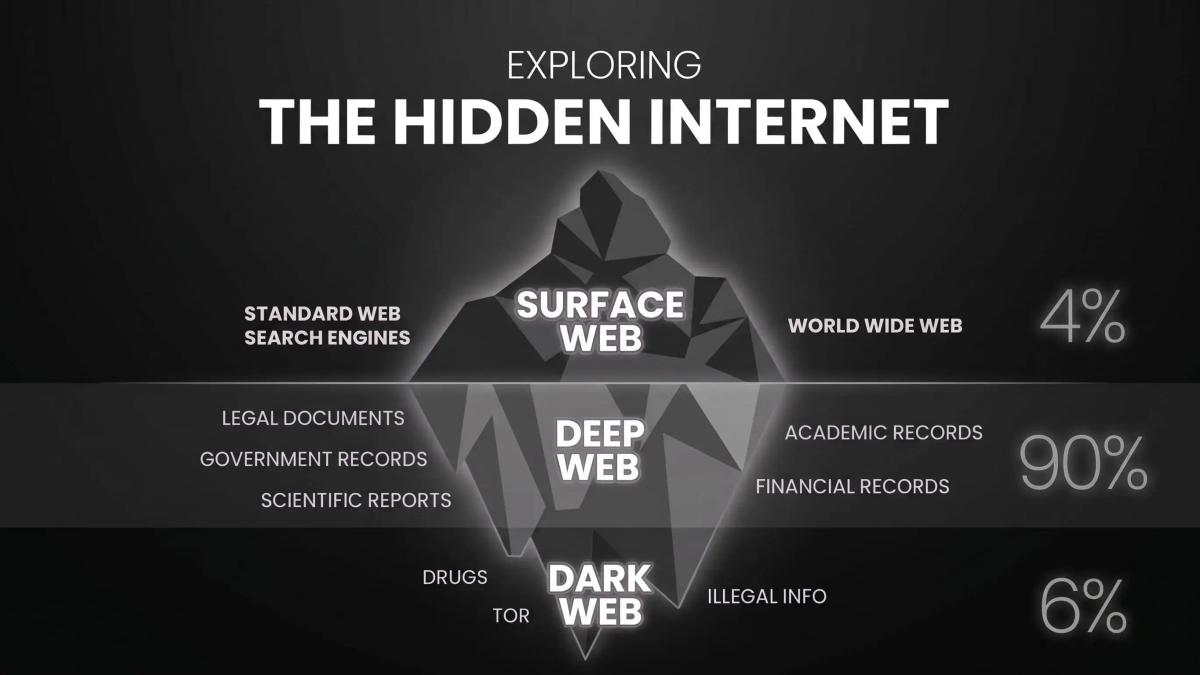
The internet has three layers: the surface web, the deep web and the dark web.
The surface web is the part most people know. It's the public websites you find through search engines, such as news sites and Wikipedia. But it's only the visible part.
A large amount of online content never shows up in search results. In most cases that isn't suspicious at all. It's content that shouldn't be public, like your online bank or a patient portal. That layer is the deep web, and it's where most private and protected information lives.
Dark web vs. deep web: what's the difference?
The two get confused all the time, but they're not the same thing. You use the deep web every day when you log in to your email or online bank. The dark web is a much smaller, hidden part of the internet built around anonymity.
| Layer | What it is | Examples | How you reach it |
|---|---|---|---|
| Surface web | Public pages that search engines index | News sites, Wikipedia | Any browser or search engine |
| Deep web | Content kept out of search results, usually for good reason | Email accounts, online banking, databases, intranets, private forums, paywalled content | A login or account |
| Dark web | A small hidden layer built to hide identity and activity | Anonymous forums and marketplaces, some of them trading stolen logins and IDs | Special software such as Tor |
Table: The three layers of the internet
The short version: the deep web protects private information. The dark web hides identity and activity.
 Expand
Why does the dark web exist?
Because some people need more privacy online than the regular internet gives them.
Hidden networks make it harder to see who is visiting a website and where they are. Instead of connecting directly to a site, traffic passes through several steps that help hide the user's identity. Journalists and activists in countries with heavy censorship use this to communicate more safely.
Criminals use the same anonymity to sell stolen data and cover their tracks. Being hidden isn't the problem. It becomes a security risk when anonymity is used to protect criminal activity.
How does the dark web work?
You reach the dark web through privacy-focused networks that sit on top of the regular internet, often called overlay networks.
The best-known is Tor, short for The Onion Router. I2P and Freenet also let you browse or share information with more anonymity.
The idea is simple: your traffic doesn't go straight from your device to a website. It takes a detour first. Tor calls this onion routing:
- Your data is wrapped in several layers of encryption.
- It's sent through multiple volunteer-run servers, called nodes.
- Each node removes one layer of encryption.
- Each node only knows where the data came from and where it goes next.
- No single node can see both who you are and which website you're visiting.
That makes it hard to trace activity back to one person. It protects privacy, and it also helps criminal activity stay hidden.
Is the dark web dangerous?
Not by default. It becomes risky because it gives criminals a place to hide and trade stolen information, mostly in dark web marketplaces and forums.
What gets bought and sold there:
- Personal information: names and home addresses, often with a date of birth attached.
- Financial information: card details and bank logins.
- Account logins: usernames and passwords for email and work accounts.
- Medical information: health records and insurance details.
- Company data: internal documents and customer data.
- Fake or stolen documents: forged or stolen passports and ID cards.
This is why dark web monitoring matters: it spots exposed data earlier, so you can act before the damage spreads. For a free first check, Have I Been Pwned shows whether your email address appears in known data breaches.
What does stolen data sell for on the dark web?
Stolen data is usually sold in bulk, often as "logs" pulled from infected devices, or as single items like card details or account logins. Most of it is cheap because there's so much of it: sellers make their money on volume. Rarer items, such as scanned passports, cost far more.
What are the risks of visiting the dark web?
The danger is less about the dark web being hidden and more about what you can run into there, and what happens if you deal with the wrong sites or people.
- Legal consequences: many dark web marketplaces are linked to illegal products and services. Accessing or buying illegal material can lead to serious legal trouble.
- Limited protection: you don't get the safety checks you're used to from regular browsers, so there may be no clear warning about a phishing page or an unsafe download.
- Malware and infected files: dark web sites can expose your device to malware, including ransomware. One download or wrong click can put your data at risk.
- Financial scams: people pay for products that never arrive, or hand over personal details they shouldn't.
- Exposure to criminal networks: some forums exist to trade stolen data and malware. Even browsing them creates legal and security risk you don't need.
Do police shut down dark web markets?
Yes. The dark web shields criminals, but it isn't lawless. Agencies like the FBI and Europol monitor and dismantle major dark web operations.
German and U.S. authorities carried out the 2022 takedown of Hydra Market, at the time the world's largest dark web marketplace. In 2023, Operation Cookie Monster seized Genesis Market.
What to do if your data is on the dark web
If you get an alert that your information has turned up on the dark web, don't panic. Work through these 5 steps:
- Change your passwords right away. Start with your email and bank. A password manager can create a unique password for every site.
- Turn on multi-factor authentication (MFA). Even if a criminal has your password, MFA adds a second step they usually can't get past.
- Check your statements or freeze your credit. Ask your bank to look for unauthorized transactions and, if needed, place a credit freeze to stop new accounts being opened in your name.
- Scan your devices. Run a full scan with reputable anti-malware software to make sure no "info-stealer" trojans are active on your computer.
- Revoke third-party access. In your account settings (Google, Facebook and so on), log out of all active sessions and remove "authorized apps" you no longer use.
If it's your email address that turned up, here's what happens when your email is on the dark web. For the longer-term clean-up, read how to protect your digital footprint.
How Serus monitors the dark web for your data
The dark web may be hidden, but your personal and company data shouldn't be a blind spot.
Data on the dark web can't be taken down, and we won't pretend otherwise. What Serus does is monitor the dark web and breach databases 24/7 for your email address and passwords (plus other personal data), and alert you when they appear. That gives you time to change passwords before anyone uses them.
- Exposure alerts: Serus alerts you when your data shows up in a breach or on the dark web.
- Clear next steps: every alert tells you what to do about it.
- For individuals and teams: protect yourself, or cover executives and staff at scale with Serus for Business.
Want to know where you stand? Run a free scan.
 Expand
Questions
Is it illegal to visit the dark web?
The dark web is not illegal by default, and some people use it for privacy or secure communication. Accessing or buying illegal material there can lead to serious legal consequences.
How do people access the dark web?
Through privacy-focused overlay networks that sit on top of the regular internet. Tor is the best known, and I2P and Freenet offer similar anonymity.
What is onion routing?
It's how Tor hides who you are. Your data is wrapped in several layers of encryption and sent through volunteer-run servers, and no single server can see both who you are and which site you're visiting.
Can you remove your data from the dark web?
No. Data on the dark web can't be taken down. What you can do is monitor for it and, when it shows up, change your passwords and turn on multi-factor authentication.
How can I check if my email is on the dark web?
For a free first check, Have I Been Pwned shows whether your email address appears in known data breaches. Dark web monitoring keeps watching and alerts you when your data appears.

Author
Anthon WanslandHead of Product & Co-Founder
Shapes the Serus product — from the first address-removal service to the platform it is today.

Reviewed by
Argjent Sahiti